Personal Loans Australia Car Loan Repayment Calculator
Explore potential car finance repayments with our Car Loan Repayment Calculator. Test different loan amounts, interest rates and repayment periods, and view detailed amortisation charts to see how repayments, interest costs and loan balances may change over time.
Calculator results are estimates based on the inputs and assumptions used and are provided for general information only. They are not quotes, offers, approval or eligibility decisions, or personalised recommendations. Actual loan costs and repayments may differ.
Car Loan Details:
Important!
Car Loan Interest Rates differ from lender to lender and will depend on your individual circumstances (credit history, employment status, age, etc.).
Car Loan Amortisation Calculator
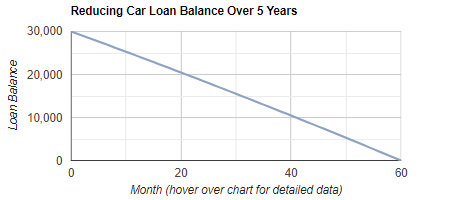
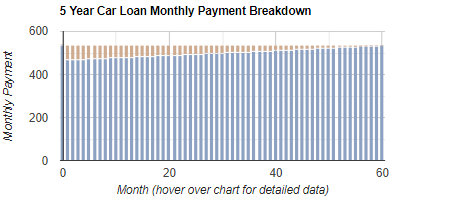
The following amortisation graphs detail month-by-month data on the progress of the proposed loan. The first chart below examines the reducing loan balance over the course of the finance contract term. The second graph illustrates the portion of each monthly repayment allocated to payment of interest vs principal reduction.
How to use our Car Loan Repayment Calculator
Our Car Loan Repayment Calculator helps you estimate repayments for an Australian car loan and see how your balance, interest and principal change over time. It is important because small changes to the loan amount, term or interest rate can materially affect your monthly budget and the total interest you pay. The amortisation charts make it easier to compare scenarios and choose a structure you can afford with confidence.
General information only: This calculator provides an estimate and does not take into account your objectives, financial situation or needs. Results are indicative and your actual interest rate and repayments will depend on the lender, your credit profile and the final loan contract (including fees and conditions).
How to complete each section for the best result:
1. Purchase Price
Enter the vehicle purchase price as a whole number (no decimals or commas). If you plan to borrow extra for on-road costs such as stamp duty, registration or insurance, include those amounts here so the estimate better reflects your likely loan size.
2. Deposit or Trade-in Value
Enter your cash deposit and/or trade-in value as a whole number. A higher deposit reduces the amount financed and usually lowers repayments and total interest.
3. Term of Loan (Years)
Select the number of years you want to repay the loan over. Shorter terms usually mean higher repayments but lower total interest. Longer terms can reduce monthly repayments but typically increase total interest paid.
4. Interest Rate (% per annum)
Select an interest rate to simulate. If you have a quote, choose the closest rate. If comparing options, run multiple calculations to see the impact of different rates.
5. Calculate
Click calculate to generate your results and charts.
How to interpret the results:
1. Repayment estimate: Use this as a starting point for affordability, leaving buffer for running costs and rate changes.
2. Amortisation charts: One chart shows the loan balance reducing over time; the other shows how early repayments are often interest-heavy and gradually shift toward principal repayment.
3. Comparison planning: Re-run the calculator with different terms, deposits and rates to identify a repayment level and total interest outcome that suits your budget.
Embarking on the journey to secure a personal loan can often seem like navigating through a complex financial landscape. Particularly for Australians, where the market is bustling with a multitude of lenders each with their respective criteria and rates, increasing the chances of loan approval is a pursuit that requires insight and preparation. - read more
In today's financial climate, many Australians find themselves exploring options to manage and optimise their financial commitments. One option gaining popularity is loan refinancing. But what exactly is loan refinancing, and how can it benefit you, especially without negatively impacting your credit score? - read more
In the dynamic landscape of Australian finance, the emphasis on a robust credit score cannot be overstated. A favourable credit score serves as a gatekeeper to a world of financial opportunities, determining the ease with which individuals can access loans, the interest rates they will be eligible for, and even the prospects of securing a home in an ever-competitive market. As the average mortgage sizes surge to unparalleled heights, the significance of maintaining an advantageous credit profile escalates in tandem. - read more
The Reserve Bank of Australia’s October 2026 Financial Stability Review offers a measured but important message for households weighing up personal loans: most borrowers remain resilient, yet pressure on budgets has not disappeared. The review, prepared using data available to 25 September 2026, points to higher inflation and interest rates as key reasons real household disposable income slipped slightly in the first half of the year. - read more
The Reserve Bank of Australia’s latest retail payments update offers another useful snapshot of how households are managing everyday spending, card use and short-term credit. While payment data is not the same as loan approval data, it can still tell borrowers something important: the way money moves through a household each month can affect how comfortable a lender feels about future repayments. - read more
The Reserve Bank of Australia’s latest lending rate statistics are a useful reminder that personal borrowing costs can vary widely, even when the broader cash rate outlook appears steady. For households considering a car loan, debt consolidation loan or unsecured personal loan, the key issue is not simply whether rates are rising or falling. It is whether the loan being offered is affordable, suitable and competitive for the borrower’s circumstances. - read more
Asset Allocation: An investment strategy that aims to balance risk and reward by apportioning a portfolio's assets according to an individual's goals, risk tolerance, and investment horizon.